Business Mission
In the context of this Model, a Mission statement
aligns with a Vision [the Ends],
describes the Effect(s) to be achieved by some Business Activity(s) [the Efforts].
Discussion
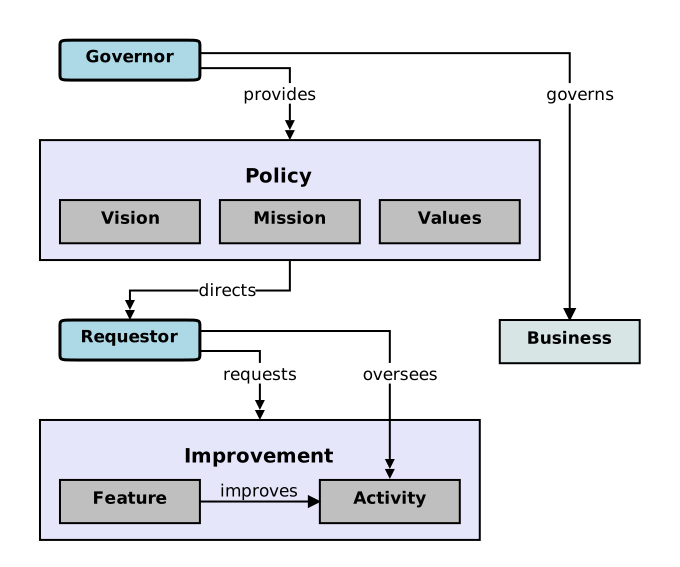
During the mid 1970s, John Carver created the breakthrough Policy Governance model for board leadership. Carver recognized that values permeate and dominate all organizational life. For this reason, the Policy GovernanceSM model emphasizes values, vision, empowerment and strategic leadership.
Creating a Mission Statement that Makes a Difference provides Carver’s essential guidance on crafting mission statements. His primary recommendation for mission statements is that they reflect the intended ends of an organization, rather than its means. These ideas can be summarized as follows:
- Ends versus Means.
An ends statement describes what difference the organization will make for its beneficiaries in the outside world, rather than merely describing what the organization will be doing (its means) to effect those ends.
- Effects versus Efforts.
A well-formed ends statement describes the results and effects to be achieved by the staff, rather than their efforts and activities. Hence, an ends statement should not include verbs, which are indicative of activities rather than effects.
- Broad versus Narrow.
A well-formed ends statement describes the appropriate, realistically achievable scope and size of the mission. Too broad a scope will be unrealistic or unachievable. Too narrow a scope will not cover the range of intended effects.
- Value Chain versus Net Value Added.
A well-formed ends statement articulates the net value contributed by the organization within its context, especially the contribution to the value chain within which the organization is situated.
Ends are best expressed as effects that are qualitative (valuable) changes in the world. Thus, ends are best expressed using adjectives that describe the intended effects, i.e., a state (of being) to be achieved. Descriptive adjectives especially indicate such states of being. For example, compare:
depot safety, or a safe depot.
While subtle, this simple linguistic shift can have a profound impact on how we conceive of and discuss business quality concerns and the intended ends of a business. As the expression of a concept shifts from noun to adjective, the emphasis likewise shifts to a concern for some measurable quality.
As in this example, what makes a depot safe? What are the measures associated with a safe depot? We can explore these questions more fully using a series of trace cards. However, we can begin by considering safety as a mission theme.
Copyright 2003,2020 Nikolas S. Boyd.
Permission is granted to copy this document provided this copyright statement is retained in all copies.